Death of Death Pt 4: Divine Data
I'm loathe to talk about Bryan Johnson in this newsletter, as it feels like his shark has jumped (there's also the ongoing lawsuit by a former employee/his ex-fiancé, and his association with convicted sex offender Jefferey Epstein). But I must. Because Bryan is a biohacker, living in the place where data and lifestyle intersect. His "product" is his protocol. His "product" is his body. But he believes his "product" is far, far bigger than just that. He thinks it can save the world.
And this is why write about him, I must. For if there was a practical application of the assertion that data is divine (today, not in some speculative tomorrow), it is in biohackers like him. They are the people who abide by the numbers-go-up doctrine, wherein tracking the minutiae and observing “progress” becomes an act of faith in itself. To measure is to get closer to god.
Here's an alternative view: measurement can cause all the same kinds of problems that Size 0 does, or fat suits did, or that the whole of the 1980s media landscape hard-wired into women of a certain age. Measurement can mess you up.
And this is why Bryan Johnson must appear here.
First, a bit of background.
Before he launched Blueprint (the product), before the Don't Die documentary on Netflix, I had the chance to interview Bryan for the BBC Radio 4 series The Immortals. We were looking to speak with someone who had transfused "young blood" as a rejuvenation treatment, and he fit the bill. At the time, he was giving away his insights about his body on his website, presenting his daily routine like it was a recipe book, and ongoing measurements as proof of success. He was effectively offering himself up as a sacrificial lamb, for the benefit of the rest of us.
When two months after speaking with him he started charging people almost $400 per month for access, I was not at all surprised. To "give" as a slow burn for a business opportunity is a named strategy. Then came the personal appearances. Not long after that, he announced he was starting his own religion.
Wellness and health have for a long time been in an uncomfortable clinch with virtue. According to scholar the Rev. Dr Melanie L. Dobson, this stretches as far back as Thomas Aquinas in the thirteenth century: ‘health constitutes not just a status for Aquinas,’ she wrote, ‘but a moral activity in which every person participates . . .’
The global wellness industry is currently valued at $6.3 trillion. Not counting creams, pills and injections, the ‘basic’ wellness protocol – healthy eating, nutrition, weight loss and physical activity – is worth just over a third of this, or $2.2 trillion. It’s never been easier to track just how healthy you are – and how healthy you are not.
‘We no longer avoid sinning for fear we’ll be shut out of heaven; instead, we avoid unhealthy behaviour for fear it will make us sick,’ wrote feminist author Ione Gamble in the Guardian in 2022. So we celebrate the people who track their superhuman wellness feats by giving them our clicks and our attentions and our cash. To Michał Wieczorek and his colleagues writing in the journal of Public Health Ethics, health tracking has become a performance. To be healthy is to be virtuous, they write. And the only way to demonstrate virtue is by sharing the numbers that prove it.
I'm going to call it like it is: Bryan is a guy who picked himself up from a humbling breakdown (backstory), reinvented himself as many in middle age are wont to do, and managed to find his stride in a grift that maximised our contemporary obsession with "wellness". With lots of leveraging social media channels, he has optimised his lifestyle cult to make him enough cash to continue living as he became accustomed after he sold Venmo to PayPal in 2013.
I will also say this:
Biohackers like Bryan are today's moral evangelisers. They prosthelytize that we are our best selves when the numbers say so. And in the midst of a misinformation meltdown, when punters like you and me are swimming in conflicting and ambiguous messages about wellness, it feels right to turn to someone with a million followers who seems to know what we need to do to do better at, well, whatever. And follow them like gurus.
Biohacking is not the first to have wellness-as-morality front-and-centre. At the end of the 19th century, there were also high priests of the “hygienic religions”, who monetised and moralised that being “well” was the “good” response to a chaotic world of “bad” influences (dare I say a “sick” society). John Harvey Kellogg was the most influential of all these biohackers, heading up the Battle Creek Sanitarium in Michigan - originally a Seventh-Day Adventist institution founded on the principles of hygiene revealed not by science but by God Himself. Between 1874 and 1953, he published hundreds of health pamphlets – that era’s blogposts or YouTube shorts – extolling vegetarianism and decrying fashionable dress, and cashed in on the craze with his own breakfast cereals, nut butters, and nut-based meat substitutes to boot. Yum yum Nuttose.
By following him, anyone could achieve a secular state of grace. It just took self-discipline and self-control to eat healthy foods, do specific exercises, perform the recommended routines, and spend weeks at a time in his sanatoria. If you couldn’t get to Battle Creek, the supermarket offered Special K cereal, for the home health hacker. Longer lives could therefore be available to all - though the super-dedicated and the super-wealthy had a better crack at the prize.
His health fad faded (as they all do), though Kellogg’s (the company) did continue to sell their namesake’s plant-based meat product (Nuttose, and its later adaptation “Nuteena”) until 2005. Others have taken its place, and they have disappeared too, only to be replaced by the mishmash of wellness influencers we have now.
Biohackers in particular are motivated by the Quantified Self movement, which in the early 2010s took the idea of self- knowledge through self- tracking and quantified it using digital note-taking software, blogs and data visualisation tools. But rather than focus purely on the "soft" things in life - like the number of movies seen, or nights slept alone - biohacking influencers have gone gung-ho on medical measurement, I think because they can.
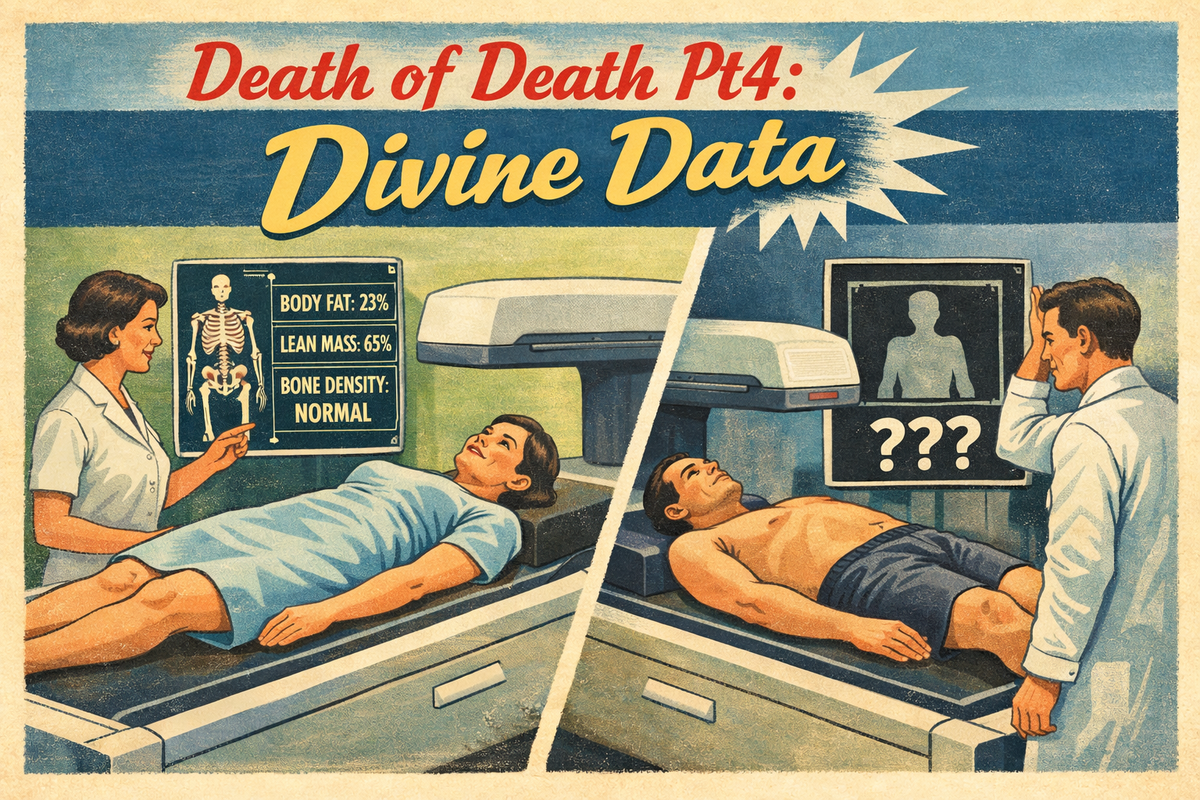
In 2023, the New York Times reported that full body scans are the new status symbol. Bryan religiously reports his biological age, his VO2 Max, and the number of erections he gets every night. There's a lot of vague understanding of what this information can offer; medical experts I've spoken with are concerned that people have data at their disposal that could cause more harm than good because it could inspire behaviour changes that undermine health and wellbeing.
Last week, I mentioned a truism in my line of work: rubbish in, rubbish out. Well, it applies here too.
‘The question to ask is not what can’t be measured, but what is not measured,’ cautioned author Amelia Abreu when I interviewed her in 2014 for BBC Radio 4's Digital Human. She was concerned that tests and trackers aren’t for everyone, yet a large proportion of everyone is using them for their somatic sense of their own wellbeing. ‘I think about the use of data- collection devices for tracking physical activity. What about emotional activity?’ she says.
‘What’s missing from the data is the ‘why’.
She continues:
‘When you limit the definitions of what needs scientific explanation to bourgeois white males, you often get a partial and sometimes perverse understanding of things.’
The biohacker regime does not consider all of us. Despite representing approximately half of the population, women are ‘a deviation from standard humanity’, writes Caroline Criado Perez in her 2019 book Invisible Women: Exposing Data Bias in a World Designed for Men. Medical interventions are not optimised for women, and women are woefully overlooked in age research. Health problems that mainly affect women are generally not studied in an integrated way; few medical schools offer women’s health courses or include gender- specific information in the curriculum. Sex and gender affects diagnoses, treatments and prognoses; for example, women are twice as likely to experience adverse reactions to medicines. Women have also been under- represented in clinical trials, which leads to under- development of medicines for female physiology. If this information isn’t present in the research going into the development of data- trackers or biohacking protocols, they won’t be optimised for women, either.
The tracking culture has transformed what we think of as “well” into a morality play:
A final thought:
I don’t think that biohackers like Bryan Johnson are entirely motivated to slow down ageing by a fear of death. I think they are masking something else with their obsession with optimisation. There will come a time when his numbers will go down. How, then, will he redefine himself?
Numbers don't entirely capture whether we are well or not, and by relying on them alone biohackers have lost touch with the ebbs and flows of themselves. We are not only the sum of our parts, but the squishy, emotional and immeasurable spaces in between. The biohackers are defined by their data, but are they paying attention to the right things?
Next week, we look at how this technological mindset is changing the industry of health.
Pre-order the book of the first season NOW and get the full copy of The Immortalists: The Death of Death and the Race for Eternal Life when it’s released in the US on March 3, 2026!