The Death of Death Pt 2: Dogma
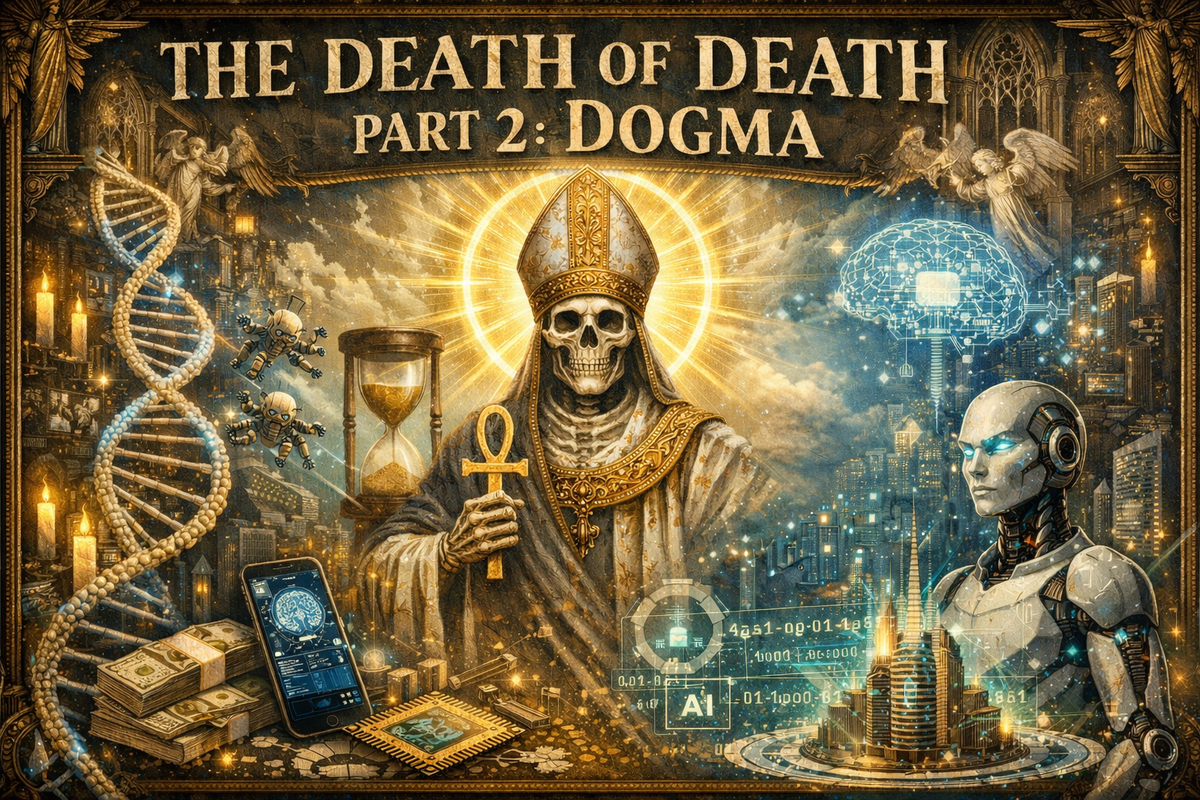
Somehow, I didn't think I was going to be writing about religion when I started down this path towards immortality. I thought I'd be investigating finances, exposing hubris, and uncovering wacko "solutions" to death.
But this story is TOTALLY about religion. It's about belief, faith, and following dogma. It's about how the power of an idea drives the decisions we make, the truths we tell, and the civilizations we build (as philosopher Stephen Cave argued in his excellent 2012 book, Immortality: The Quest to Live Forever and How It Drives Civilization).
Of course it is. We're talking about the most fundamental question of humanity: how to break the shackles of our mortality. Duh.
Thankfully, my aha moment about this universal theme situation came when my commissioning editor at the BBC, Dan Clarke, suggested I have a listen to the Frozen Head from Wondery, which has possibly the best opening episode I've heard in narrative non-fiction.
The leading story here was about a fella who decided he wanted to be cryopreserved - frozen immediately after death - so that he could be revived at some point in the future when what he died of would be fixable. So far, so wacko.
The secondary story was about the founding of Alcor, the leading cryopreservation organisation in the world that to date has over two hundred whole bodies and heads of frozen customers (and pets) already in its vaults in Scottsdale Arizona desert (yes, these human remains are kept on ice in the hot hot desert - so far, so hubris), and a membership list of 1,500 more.
But the actual story of the series - and the one that turned my approach to writing about immortality on its, er, head - was about what we believe happens after we die. Cleverly, this isn't stated outright; it's told in beautifully crafted narrative: the man who wants to be frozen is married to a woman who's not sure. She dies first. He sends her to Alcor to be processed, where they remove her head (it's cheaper than a whole body) and plunge it into -110F.
He then ends up locked in a forever legal battle with her family, because they believe her body was taken against her wishes. They don't get to visit a gravesite, or have a memorial. They believe that when we're dead, you're dead, and we ain't coming back. They think he's got a wacko belief that the two of them will be able to live forever, eventually, in an imagined future. If you'll allow me, a heaven.
Believes. That's the key word here. Let me put it another way: has faith that. There are two opposing beliefs at play in this story, and that's what's propels this podcast along. But more relevant to my interests, faith is responsible for a lot of irrational and emotional decision-making.
I left the topic of cryopreservation to the Frozen Head folks, and have not gone down this particular rabbit hole for a very solid reason: the folks who sign up to Alcor and the other cryopreservation hotspots have to DIE before they get to their imagined immortality. I'm not interested in people who think their lives will end. I'm more interested in the people who want to continue to live forever without dying.
Specifically, the people who believe in technology so much that it will save them.
‘When was the moment you realised you didn’t want to go for pizza and a beer after work?’ I ask Bryan Johnson, who’s sitting serenely in the half- darkness of his giant living room. Johnson quietly smiles. I sense a capital- t Truth is about to be told.
‘I’ve become the most measured person in history,’ he says solemnly. ‘The data is outputted and referenced to scientific data and a protocol is created, and I follow that protocol with perfection. My mind is not involved. My mind cannot look at a menu. It cannot peruse the pantry. It can’t participate in a spontaneous pizza party.’ He pauses. ‘I’ve built my autonomous self.’
Bryan's extremely well-documented public attempts to live forever by eating a deficit number of carefully controlled calories while exercising A LOT and taking hundreds of additional supplements according to the output of an algorithm he and his team of consultants have programmed into a "protocol" powered by AI have (he claims) led him to stop ageing. When I spoke with him in 2023, he was 45 chronological years old; a year after starting this $2m per year treatment plan, he claimed to be ageing at a rate of 277 days for every 365.
Golly, I thought. Is that all it takes? But alas, I don’t have a fraction of his faith in technology. Because that’s what it all comes down to in these immortalists’ lives: each – through a combination of fantasy, wishful thinking and mathematical reason – believes that technology is the thing that will give them eternal life. Some – like Johnson – are using it as a tool to get there in a form that is very much human. Others believe we must and will all merge with it, to become ‘post- mortal’. All are what I call techno- fundamentalists.
As we continue to become intertwined with our digital tools, we increasingly believe that technology is in control, for better and for worse. Those who think it acts in our best interest – like Johnson – prefer to let it take charge. ‘I’m trying to demonstrate there may be a new step in the evolutionary path here where our minds are not the unchallenged authority,’ he tells me. So, for Johnson, technology’s first challenge is to solve the fact that every day he is getting one step closer to six feet under.
Bryan's dogma is very similar to the Alcor members': it's that eventually the things that currently kill us will be fixed, through the miracles of science and technology. Looking backwards, you can understand why they might think this: 100 years ago, our life expectancy was half what it is today. We have cures for many diseases and causes of death across the lifespan that killed us then (though the majority of the life expectancy bump comes from addressing fatalities within the first five years of life). The extrapolation goes that if we are in a golden age of technological discovery and scientific progress (as some believe), this trend should continue. And, alongside Moore's Law, that thing about the shoulders of giants (sorry, Kaitlin), and the Law of Accelerating Returns (all of which are not laws btw - just hunches that continue to be true), they might be right.
You just have to live long enough to reap the reward.
‘When I look at the speed of technological progress, I don’t know how any human could arrive in a reasonable fashion at a cap of lifespan,’ Johnson tells me.
Now, holding back time for one year may not seem enough to live forever, but here’s why it might: think of it like a rocket leaving the earth. It needs to reach a certain speed to overcome the pull of gravity. This is called escape velocity. Now imagine that through treatments, lifestyle changes and prayers you could stop yourself from ageing. The idea is that you would eventually reach the point where each age- related disease, such as dementia or diabetes, and those that we don’t know about yet, will have been cured before your body ages into them. You would escape the pull of mortality. This is called longevity escape velocity (LEV).
Fundamentally, this isn’t living forever; it’s not dying today.
This isn't science fiction, though for many years, writers have been predicting that the moment when we successfully outrun time will arrive in the near (to their) future. most people who believe in this give us a 10-15 year horizon. Aubrey de Grey, the controversial geroscientist who has received over $6 million in research funding from billionaire Silicon Valley investor Peter Thiel, $2.4 million from crypto king Vitalik Buterin, and has coined it from other Valley visionaries since he invented the term longevity escape velocity in 2004 (hello finances), told me he believes we will reach LEV within the next five years. Ray Kurzweil, the Chief AI Visionary at Google since 2012 (and long-time Alcor member... just in case...), predicts it'll happen as soon as 2029.
With LEV their guiding light, techno-fundamentalists have thrown billions into all kinds of different technologies that they believe will delay the ageing process. In my reading of it, there are two prime candidates: nanotechnology, and data.
Nanotechnology will fix all the things that go wrong in our bodies, argues Kurzweil.
‘We will do this by replacing the cell’s nucleus with a nano- engineered counterpart, which would receive an upgraded DNA code from the central server,’ he said to an audience at the 2022 RAADFest (Revolution Against Ageing And Death Fest), a life-extensionist's conference currently co-produced by a group described as a New Religious Movement, and de Grey. Kurzweil explained that this life hack would fix anything physically wrong with us at the precise point where it is going wrong.
‘We’ll be funnier, sexier, smarter, more creative,’ Kurzweil said to the audience. ‘We’ll be able to produce an optimised body at will. So we’ll be able to run faster, longer, whatever we’d like to do – climb Mount Everest for vacation! Sit at the bottom of a pool without drowning! We’ll get to a point where we’re no longer dependent on the survival of our biological bodies for ourselves to survive!’
In the near future, our brains will ‘eventually become more than 99.9 percent nonbiological’, Kurzweil promised in Wired in 2024. We will have synthetic neurons which will update according to the instructions of a central control system that will live in the cloud. This will communicate with the digital layers of our neocortex. The digital neocortex is what Elon Musk is building with his brain– computer interface company Neuralink.
Musk explained why we will need this to an audience in January 2017 at the Future of Life Institute’s Beneficial AI conference.
‘We’re bandwidth- constrained, particularly on output,’ he said. ‘If you want to be generous, you could say maybe it’s a few hundred bits per second . . . The way we output is like we have our little meat sticks that we move very slowly, and push buttons or tap, tap a little screen.’
He’s referring to our fingers.
‘Compare that to a computer which can communicate at the terabit level . . . We have to solve that bandwidth constraint with a direct neural interface, I think a high- bandwidth interface to the cortex, so that we can have a digital tertiary layer.’
Why, you might ask? To
‘achieve a symbiosis with artificial intelligence’.
Oh lord.
Why talk about AI in a newsletter about immortalism? Because apparently this tool is the one thing that’s going to actually, finally, decode humanity, thus rendering both our minds and our bodies solvable.
‘Technology brought us from the Stone Age to the Agricultural Age and then to the Industrial Age,’ wrote Sam Altman on his blog in 2024. ‘From here, the path to the Intelligence Age is paved with compute, energy, and human will.’
The objective - of Altman, of Johnson, of Musk, of Kurzweil, and all the other AI companies currently expanding the current AI economic bubble is to create one intelligence to rule them all: Artificial General Intelligence.
Once we have AGI, the prophets predict we should be able to discover all kinds of new treatments for ageing. Altman believes we are close. ‘We can now imagine a world where we cure all diseases, have much more time to enjoy with our families, and can fully realize our creative potential,’ he wrote in 2025.
But why stop with general intelligence, argues Nick Bostrom, the most well-known moral philosopher in Silicon Valley, and author of Superintelligence: Paths, Dangers, and Strategies.
According to Bostrom, the path towards radical life extension won’t go through biomedical research. It will instead go through superintelligent AI - crudely put: an artificial intelligence that knows everything, and then some. That can make its own decisions, its own connections, its own assumptions, its own conclusions. It's not just superhuman.
‘Thinking of a superintelligent AI as smart in the sense that a scientific genius is smart compared with the average human being, it might be closer to the mark to think of such an AI as smart in the sense that an average human being is smart compared with a beetle or a worm.’
So once it arrives, and we can connect with it (through Musk's Neuralink, presumably), we can ask it, like, so how do we live forever, yo?
And it might answer.
I ask him if he wants to live forever. ‘I think I’d want to have the ability to postpone making that decision,’ he says, characteristically. ‘I think you’d need at least a few thousand years to ponder this question before you would be ready. But even then, I think it would be better to make it piecemeal, this choice. You decide, “Would I prefer to die now or live another year?” And then if you choose to live another year, you can revisit that question, and if the end result is that you live for a very long time, then so be it.’
He's converted Elon Musk, Bill Gates, and a whole lot of other people too.
OK, this has been a lot of information. And I haven't even explained how data wll be used yet. Today, we started with frozen heads and now we've ended up at artificial superintelligence. Let me sum up.
I just can't.
In our next installment, what's data got to do with it, and a provocative idea:
That's for another newsletter. Keep your inboxes open for more.
Subscribe! And follow along! And even better:
Pre-order the book of the first season NOW and get the full copy of The Immortalists: The Death of Death and the Race for Eternal Life when it’s released in the US on March 3, 2026!