The Death of Death Pt 5: Holy Health
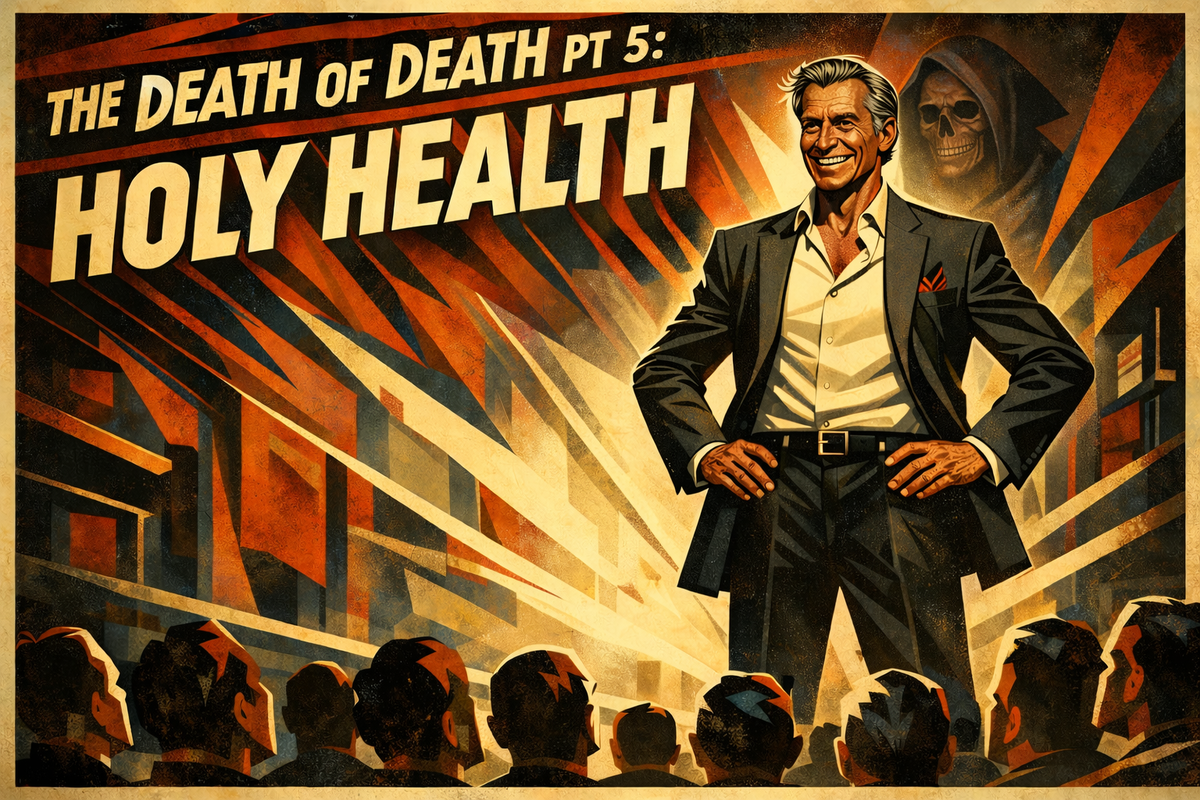
It’s early October 2022, and the sun is scorching in downtown San Diego. In the ground- floor conference room of the Town and Country Resort, a charismatic man is vigorously pacing back and forth across the stage in Italian loafers. He’s wearing a fashionable slim- cut suit, shirt open at the collar to reveal a tanned chest. He has swept his movie- star chestnut hair back from his crease- free forehead. Like Bryan Johnson, very few of his facial muscles move when he speaks. The only giveaway of his golden years are his eyes, which are so conspicuously aged that he looks like a collage of a person assembled by an alien.
‘I want to see you all dancing next time when this music plays,’ he chides in a surprisingly high- pitched, unaccented American voice, ‘because look – we’re supposed to be the most alive people on the planet, aren’t we?’
James Strole, co- founder of RAADfest, anti- death activist, and Executive Director of the Coalition for Radical Life Extension, is glistening in the bright lights as the thousand- strong audience whoop and holler at his feet on Day 1 of the three- day gala.
‘We should show it! We can’t be afraid of showing it! We need to really come out there with our aliveness! It’s good for our immune systems!’
The room of mostly over- sixties get up from their chairs and give Strole his first standing ovation of the morning. The majority of the attendees are sagging in the correct places, but there are many faces and figures with the telltale signs of plumps, fillers and lifts. This room is full of the radical life extension- curious, here to celebrate the Revolution Against Aging and Death (RAAD). Strole, their leader, gently raises his palm. They fall silent.
‘Everything we’re all experiencing, human beings are experiencing, these last couple of years, seeing people that we care about and love pass. Seeing people get sick at enormous rates. Much less the environment that has not been very conducive to really being excited about living.’ The audience murmurs. They’ve had to work overtime to keep the faith during the COVID- 19 pandemic.
‘A few months ago,’ Strole whispers to the room, ‘I began to feel a new strength that I’ve never had before. There is a new spirit of energy coming out of me.’ A few Oh- Yes- es and I- See- It- s.
‘We need to have a spirit of immortality, a strength in our bodies!’ he commands. The crowd struggles up from their seats again.
‘I feel like there is a tapping into this immortal lineage, or whatever we want to call it, in our bodies to let there be a new birthing of life!’
Strole soaks up the rapturous applause.
RAADfest is billed as a global age- reversal public event. It is,
the largest and most immersive event in the world focused on super- longevity for a general audience. Bringing together cutting- edge science, inspiration, entertainment and fun, RAADfest is more than just a conference – it’s a celebration of life. From brain longevity and sexual health, to senolytics, personalized medicine and helping your pets live longer too, RAADfest provides the information and inspiration to enable people to take charge of their longevity.
Despite its unusual subject matter, it looks like most corporate events: a line- up of luminaries, lots of congratulatory back- slapping, networking breaks, sponsor adverts, and an expo hall where you can sample the latest products to keep death at bay.
‘The innovations and the therapies that are available there are extraordinary,’ Strole enthuses from the stage. ‘I got an IV today and I want to encourage you guys if you need a little boost to your immune system, get an IV.’
An IV of what? There’s a whole menu to choose from. Plus there are countless creams and headsets and cold plunges and injections and mushroom vitamins and blood panels in every booth.
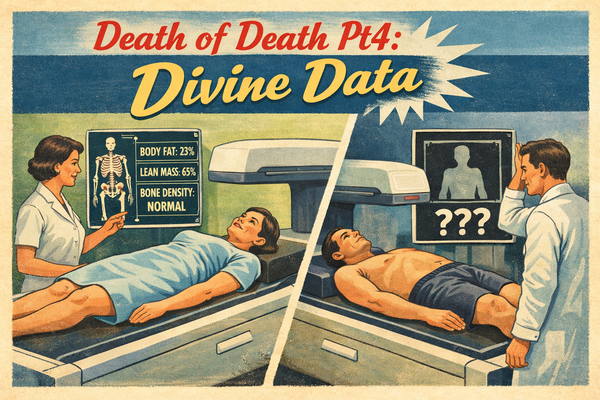
‘There’s a DEXA scan. That is a very, very low price for DEXA scan, by the way,’ continues Strole, describing a diagnostic test that measures bone density – usually to identify osteoporosis, but which has become a popular biohacking and wellness tool to help tell what are normal age- related changes and what are not.
‘And there’s so much more. So much more, so much more. There’s so many fantastic things you can do. Yeah, I’m signed up for, like, twenty- seven things.'
I need a glossary to decipher most of the treatments. I’m starting to feel like I’ve missed the memo. It’s a lot to assimilate, but Strole assures us: ‘Don’t worry about what you don’t understand at the moment. The longer you’re in the conversation, the more you get really clear what you need to apply for yourself.’
RAADfest is ‘the Woodstock of biotech’ (not the Coachella - it's targeting a specific group of hopefuls). By 2022, its seventh year, RAADfest attendance was averaging around 1,000 people. People came from all over the world, paying $727 for the most basic tickets and $2,997 for access- all- areas passes.
As I tuck into a complimentary plate of organic food, I thumb through an app that uses ‘ancient technologies’ to retrain brain waves to be resilient to modern chronic toxic stress. It’s not helping. I wander past a pitch for ‘bliss in a bottle’ cream, which the presenter says has resolved muscular atrophy and paralysis with one application. He saw it happen himself. Most of the plenary talks tread a version of the same path: we have been fooled into thinking that ageing is inevitable; it can be conquered with a simple solution; here’s an app/cream/ injection/treatment that uses the science ‘they’ are keeping locked up in their labs, or that the government doesn’t want you to access. I can’t see a single treatment on offer that’s been FDA approved – and many people are seeking funding for clinical trials. Tech entrepreneurs with deep pockets are roaming the aisles looking to get in early on a treatment that could make them their next million. Everyone here is a believer in some way.
Perhaps none more so than James Russell Strole. Born around 1949, he has actively pursued a life that never ends for more than fifty years. In fact, he believes that humans don’t actually need to seek immortality because we are fundamentally physically immortal. Yet somehow, as civilisation has evolved, we’ve forgotten that. Instead, we’ve found ourselves trapped in a powerful cult of death where systems are designed to sustain themselves at the expense of our own lives. This is evident in how financial systems, work environments, urban development and even how we envision the future all hinge on replacement, rather than renewal. And because it serves how the world is currently organised, he believes we have been indoctrinated into this progress towards finality, and now we imagine only the spirit will live forever, not the flesh.
Death doesn’t have to be this way, says Strole and his believers. It’s time to end The End. If we make an effort to live well, by taking care of our bodies according to the latest scientific advances, and our minds through positive thinking, there’s nothing to stop us from resurrecting our immortal lineage and living forever.
RAADfest is Strole’s marketplace. It sells improbable dreams and unverified remedies – all of which are legal, he assures us. On this year’s speaker list are lifestyle influencers on a longevity kick, entrepreneurs selling their unproven gene therapies, naturopaths promoting questionable injections, a roboticist using AI in elder social care, and Ray Kurzweil, the Google technologist who is convinced that the way to defeat death is to merge with AI.
On stage now is Naveen Jain, a serial entrepreneur who is impossibly absolute about the future of life extension. 'I’m promising you immortality!’ announces Naveen Jain to the audience during his on-stage conversation with Strole. He looks around and catches the eye of someone a few rows back. ‘What do you think?’
The audience sways.
‘There is nothing written in our body that says you must die. Right?’ Jain leans in. ‘There is no reason and rhythm why we must die. Because at the end of the day, there is no mystery about this human body. It is simply biochemical reactions. And what if you could understand them? And if you can understand them, it’s simply about math and chemistry. It’s AI and chemistry. It is easy to fix, right?’
It’s the scientists who are fools, he implies.
‘I have a basic science degree from high school, right?’ Jain says. ‘When I graduated from high school, I learned that DNA makes RNA. Hey! And what happens in your body is determined by RNA gene expression that you can control based on what you eat, based on what you do, based on your lifestyle, based on your mindset – it changes everything.’
He pauses for the gratitude, and the applause.
Jain returns to the mic: ‘Thank you. This is why I want us to go deeper with this mindset . . . For me, I want to go all the way to immortality.’
Death is always a threat to immortalists, writes Jeremy Cohen, a religious studies scholar at McMaster University in Canada who’s studied RAADfest and the techno- immortal beliefs of Kurzweil. If you die, you have ‘not lived a sufficiently immortal lifestyle by eating well, taking the right supplements, being an active immortalist, and always cultivating a positive mindset.’
Dying is ‘lazy’, according to now-deceased RAADFest co-founder Bernadeane Brown. It is ‘not intelligent’. According to Cohen, anyone who ends up dying (like Bernadeane) did so because they were hiding death within, by not taking care of themselves, by being greedy, or being immoral in some other way.
They weren’t holy enough to live.
Eternal life doesn’t sound very relaxing; in the immortal universe, you might live forever with immortal anxiety. As an inverse of the sink or swim test in early modern witch trials, the only way to ever know if you are pure enough is if you don’t kick the bucket.
So how should we face death? Denying it, like Strole and Jain? Or fighting against it, like Bryan Johnson and the biohackers? Or accepting it? Lucretius, who is credited with bringing Epicurean philosophy to Rome, wrote in the middle of the first century bce that ‘Death is nothing to us. We shall not be conscious after death any more than we were before birth. Death, then, is naught to us, nor does it concern us a whit, inasmuch as the nature of the mind is but a mortal possession.’ This would be a compelling argument, except for one important thing: we can see death happen to other people.
Philosopher Stephen Cave, author of the excellent Immortality: The Quest to Live Forever and How It Drives Civilization describes this as the essence of our ‘mortality paradox’: we can’t imagine a time when we are no longer here, but we know that it will come because we have experienced the loss of others. So in our grief and existential meltdown, some choose to reject death and pursue immortality.
And so I return our attention to the faithful tech immortalists who are convinced, beyond a shadow of a doubt, that all they need to do to solve our mortality is to set their machines on the problem and let them figure it out. And they've hit on a story as good and as convincing as James Strole's: never stop believing.
It's turning their religion into a billion dollar industry driven by the hype and hyperbole of Silicon Valley. That's next week.
Pre-order the book of the first season NOW and get the full copy of The Immortalists: The Death of Death and the Race for Eternal Life when it’s released in the US on March 3, 2026!